

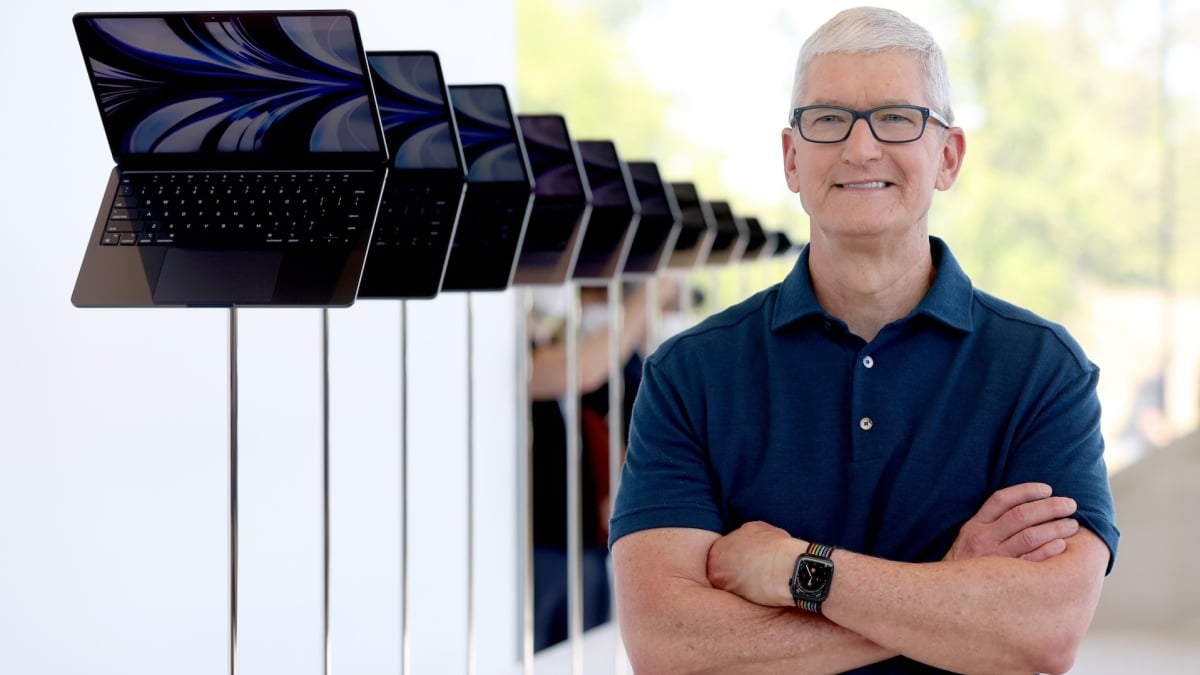
Few CEOs ever arrived in the job with as tough an act to follow as Tim Cook did in 2011, replacing the late great Steve Jobs in his fast-declining days. Fewer still rise to the occasion — and get to leave so extraordinary a legacy to the next guy.
Apple’s head honcho, age 65, announced Monday that he’ll be stepping back come September. Cook will step into an emeritus role as Executive Chairman, while John Ternus takes the reins as CEO.
And out of all the major technological, financial, and logistical achievements of the past 14 years — which we’ve listed below — some business experts believe this in itself may be the greatest.
1. Apple’s second successful succession
“Cook’s legacy will extend beyond any products or shareholder value he created,” Laurie Barkman, adjunct professor of entrepreneurship at Carnegie Mellon University’s Tepper School of Business, tells Mashable. “Two successful transitions at the highest level do not happen by chance. They reflect a process embedded in the company’s operating model.”
Given how often ego-driven CEOs make a mess of their succession, paralyzing their executive team in the process — heck, just watch Succession for a taste of how bad it can get — this is no mean feat. That kind of operational mess is one of the reasons the average S&P 500 company lasts just 18 years.
But Cook, formerly Jobs’ Chief Operating Officer, was always known for sweating the logistics details. And that’s why Apple just celebrated its 50th birthday, looking more secure than ever.
Crucially, during Apple’s lean years before the iPhone, Cook saved the company by keeping inventory as low as possible. Controversially, he’s kept his China-dependent tech giant growing during a year of high tariffs by any means necessary, including cozying up to a president who doesn’t reflect Cook’s California values.
Now, by handing over the reins in such a calm and clear fashion, at a time of his choosing — as much as two years earlier than some analysts expected — Cook is showing off the well-oiled machine that Apple has become.
In short, taking Apple from “a one-time founder handoff into an institutional succession,” Berkman says, should be regarded as “Tim Cook’s greatest accomplishment.”
2. From Jobs’ billions to Cook’s trillions
The mercurial Jobs may have co-founded Apple, and he may have championed Apple’s ultimate money-making product, the iPhone, during his 1997-2011 return. But Jobs’ own ego-driven exit from the company in 1985 meant years were wasted in the wilderness, and even once he returned, he had to spend a decade pulling Apple back from the brink of irrelevance and extinction.
It worked, of course; Jobs bowed out when Apple shares were worth $350 billion in total, or $349 billion more than when Jobs took the company public. But consider what Cook did: his steady hand on the tiller took the company from $350 billion to more than $3.9 trillion in shareholder value.
Under Cook’s tenure, Apple became the first company in the world to pass the $1 trillion and then $2 trillion mark. Only one tech company can claim that it created more shareholder value in the last 15 years, and that’s NVIDIA — the main beneficiary of the AI craze.
Mashable Light Speed
And how did Cook do this? In large part, by making sure the iPhone didn’t go the way of the original Macintosh. The Mac was beautiful, pricy, and rapidly snowed under by boxy beige PCs running the Macintosh-like Windows, which almost killed Apple in the 1990s.
The smartphone wars looked like they were going the same way, with cheaper Android phones, particularly models made by Samsung, in the Windows seat. But thanks to Cook’s diligence, Apple just overtook Samsung as the world’s most popular smartphone manufacturer.
3. Apple made something new
Tim Cook, it’s fair to say, is a pretty cautious guy. He prefers to iterate rather than innovate. The iPhone 5, the last version of the device developed under Jobs, wasn’t too many worlds away from the iPhone 17 unveiled by Cook last year. The most memorable upgrades in between — the iPhone 7’s lack of headphone jack, the on-screen notch in the iPhone X, last year’s Liquid Glass — felt like tinkering around the edges.
The same goes for the iPad, introduced in 2010; the MacBook, introduced in 2006; and the Apple TV device, introduced in 2005. Design tweaks, cameras, color choices, and under-the-hood upgrades aside, these devices are all pretty much the same as they were when Steve Jobs last stepped into an Apple Store in 2011.
But there are a few new major Apple product categories Jobs wouldn’t recognize — and we’re not just talking about the Apple Vision Pro. (Jobs may at least recognize the reality distortion field Cook’s company built around this pricy augmented reality headset, and he’d probably agree with Cook’s move to pivot to smart glasses as soon as possible.)
The biggest product launched during the Cook era is the Apple Watch. First conceived by designer Jony Ive after Jobs’ death and unveiled in 2014, the Apple Watch quickly became the world’s top wearable. More than 100 million people currently use one, even if Apple Watch updates are the least exciting part of a modern Apple keynote event.
And then there’s the AirPods family of Bluetooth headphones — original (2016), Pro (2019), and the over-ear Max (2020). All were well received, and their success had a lot to do with Cook’s acquisition of Dr. Dre’s Beats headphones company for $3 billion in 2014. Arguably Cook’s riskiest move, the Beats purchase has since paid dividends — in headphone expertise as well as Beats sales.
4. Apple became a streaming giant
Never mind the Apple TV device, which would probably have found its way to a 4K version by now, no matter who was CEO. Cook’s larger legacy is the other Apple TV, a.k.a. the streaming service formerly known as Apple TV+. Launched in 2019, its secret sauce was Apple Studios, which took care of the all-original programming.
By focusing on quality and courting the biggest names in Hollywood, Apple Studios racked up an impressive series of wins in a short space of time. CODA (2021) became the first Best Picture Oscar-winner from any streaming service; Netflix had been chasing that prize for a decade. Killers of the Flower Moon (2023) made Martin Scorsese’s passion project a hit in theaters, and F1 (2025) became the highest-grossing sports film of all time.
Apple TV shows, meanwhile, have done what seemed impossible in the age of almost-infinite streaming. They’ve cut through and become part of the cultural conversation in a way we haven’t seen since Game of Thrones. Just as that show came to define TV in the 2010s, the 2020s are practically owned by Apple hits such as Emmy darling Ted Lasso (2020-), Severance (2022-), and Vince Gilligan’s Pluribus (2025-), the latter quickly becoming its most-watched show ever.
And as if that wasn’t enough, Apple went to town on sports programming (MLB, MLS, Formula One), kids’ shows and movies (Sesame Street, Charlie Brown), plus one word: Oprah. If any streaming service is starting to resemble an old-school TV network with a new flavor, it’s Apple TV. And by giving away a free year of subscription with Apple products — while resisting annoying Amazon-style ads — Cook has cannily ensured millions of us get hooked on its output.
5. Avoiding the AI trap
Conventional wisdom holds that Cook’s greatest weakness during his 15 years was his approach to AI. When ChatGPT was conquering hearts and minds in 2023, Cook was loath to even use the acronym AI in the pre-recorded keynotes he pioneered. Instead, he said Apple software had already been using “machine learning” for years. (Fact check: true.)
Cook’s belated compromise came in the form of Apple Intelligence, powered by an on-device version of ChatGPT — but Apple’s creaky 2011-era voice assistant, Siri, stood out like a sore thumb (pending a major 2026 upgrade). Even now, Cook seems to be betting that a quiet majority of consumers were turned off by AI and wanted its features to be limited, with a focus on privacy, accuracy, and mental health protections.
Cook may yet be proved right. Because here’s the thing about tech world conventional wisdom: it’s almost always wrong when applied to Apple.
Conventional wisdom said the company should have sold itself to Microsoft in 1997, leaving (we now know) $3 trillion in value on the table. Conventional wisdom said the original iMac should have had a disk drive and no USB ports; it single-handedly made USB a global standard. Conventional wisdom said consumers would never buy an MP3 player with a mere 5GB of storage; enter the iPod.
If the Cook-Ternus version of AI turns out to meet consumers where they’re at, rather than wowing tech media and investors first with outrageous claims, nobody will care that Apple took a few years to get there. If Apple Silicon (particularly the AI-friendly M5 chip) is ultimately more important than NVIDIA’s specialist GPUs — which they will be, if data center expansion continues to stall — then the company Cook built will easily snatch back the “world’s most valuable” crown from its rival.
And Tim Cook, Apple CEO emeritus, will look like a very smart cookie indeed.