


When Until Dawn was released all the way back in 2015, it was a rather inventive interactive horror drama that propelled itself into mainstream gaming culture on the strength of how gloriously camp it was. With its myriad of choices and gruesome deaths, Until Dawn had a replayability and a level of enjoyment — especially for YouTubers — that made it a standout in a year already dominated by heavyweights like The Witcher 3: Wild Hunt, Fallout 4, Bloodborne, and Undertale.
Supermassive’s formula was unique at the time, heavily inspired by the adventure genre and FMV (full-motion video) games of old. But now, a decade and seven games later, that formula is starting to show its age. The latest entry is Directive 8020, the fifth instalment in the Dark Pictures Anthology, set far into the future aboard the starship Cassiopeia.
Like the other entries in the series, Supermassive knows how to make you feel genuinely terrible about a decision in Directive 8020. Unlike those earlier games, though — Man of Medan, House of Ashes, and the rest — you can now rewind your previous choices, making it easier than ever to get the full scope of the narrative without committing to any one path. Does that meaningfully change how the story is presented? Not really. But it is a significant improvement in quality of life for anyone who wants to see how the story branches without having to restart the whole thing just to make the most myopic dialogue and character decisions possible.
All that to say: from my time with the game — with a code provided by Supermassive — Directive 8020 is both a blast story-wise and an absolute drag gameplay-wise. And in the eight full hours I logged, playing through the main story and messing around with the rewind feature to hunt collectibles and explore extra choices, I can confidently say I still had some fun with Supermassive’s latest.
Directive 8020 draws heavily from The Thing and Alien

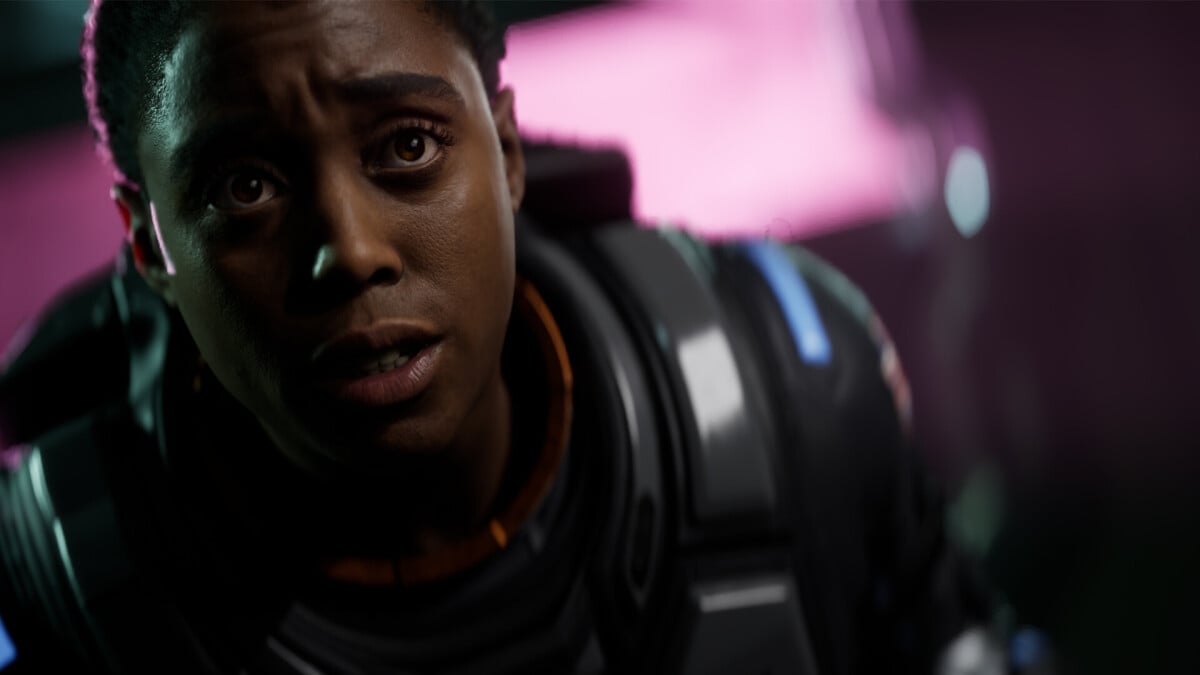
Lashana Lynch plays the ‘Directive 8020’ protagonist: pilot Brianna Young.
Credit: Supermassive Games
Directive 8020 welcomes you aboard the colony ship Cassiopeia. You play as the crew of scientists on an eight-year survey mission to the exoplanet Tau Ceti, tasked with determining whether it’s fit for human life. The problem is that an alien organism has found its way onto the ship — one that’s not only hunting the crew down but can also mimic them, turning what was supposed to be a routine survey mission into a paranoia-soaked trip into hell.
If that basic plot synopsis sounds like a spoiler, it really isn’t in the grand scheme of things. It’s the game’s central marketing hook, and it carries with it a dramatic irony that will always color your decision-making, especially on a first playthrough. Like other games in the series, the playable cast is filled with up-and-coming and lesser-known actors, this time with Lashana Lynch (The Woman King, The Day of the Jackal) in one of the lead roles. And not to go off on a tangent, but the quietly impressive awards pedigree of this franchise is always worth noting — both Rami Malek and Jesse Buckley landed Best Actor wins in the years following their respective Supermassive appearances in Until Dawn and The Dark Pictures Anthology: The Devil in Me. Fingers crossed for Lynch, then.
Mashable 101 Fan Fave: Vote for your favorite creator today.
Without getting too deep into the plot, Lynch’s character — Cassiopeia pilot Brianna Young — awakens from a four-year slumber to find one of the sleep technicians missing (they’re assigned to stay awake for the full journey to watch over the crew and ship) and the other acting really, really strange. From there, the crew must deal with a series of disturbances that derail the mission, one meant to lay the groundwork for the colonists of Andromeda to eventually arrive on their new home planet.
The story is fairly straightforward, drawing heavily on The Thing and Alien — the sentimental body-snatcher and space-horror classics, respectively. Alongside Young, who is trying to follow in her famous pilot father’s footsteps, the other playable characters include Commander Nolan Stafford, ship designer Laure Eisele, engineer Josef Cernan, and Dr. Amanda Cooper. They’re fine, which has always been a quiet problem with Supermassive games — the people we’re supposed to want to protect until the very end tend to be fairly one-note. Eisele is rational to the point of being robotic; Cernan is grappling with the meaning of life after losing his husband; and Cooper is still processing the trauma of being the sole survivor of a mass casualty event. Bog standard motivations that don’t carry much weight in the grand scheme of the plot, at least in my experience.
There are three additional characters aboard the ship who aren’t playable; their primary narrative function is as potential mimic targets who may or may not still be themselves by the time the story picks up steam. That setup also doubles as the structural backbone for Directive 8020‘s five-player co-op movie night mode.
Directive 8020 gives the illusion of choice and consequences

Be aware of the illusion of choice.
Credit: Supermassive Games
If the story is Directive 8020‘s strongest hand, the gameplay is where it overplays it. While the interactive QTE (quick time event) drama formula is getting stale, nobody picks up a Supermassive game expecting God of War. But there’s a difference between “light on gameplay” and “actively repetitive,” and Directive 8020 spends an uncomfortable amount of time on the wrong side of that line.
Supermassive has always built its games around the illusion of meaningful decisions, and Directive 8020 is no different. One of the things the developer gets right is the Turning Points system, which lets you rewind decisions and explore different branches of the story without having to blow up your entire playthrough. That’s a genuine quality-of-life win for a game built around consequence. Except some of these choices are so deceptively mundane that the consequences feel less like earned drama and more like gotcha moments.
Early on, you’re asked to reroute power from either the Cassiopeia’s landing gear or fire suppression system. Seems straightforward enough on the surface, except that picking either option comes with fatal consequences. Here’s the thing, though: this is a horror game set on a spaceship. Of course, you’re keeping the fire suppression on. Something is always going to end up on fire. Calling that a meaningful choice is generous.
And no matter what happens in any given chapter, it’s pretty clear that the story is engineered to hit its predetermined endpoints regardless of what you do. The prologue is a good example — it ends with one of the sleep technicians getting mimicked by the alien, which then chases the other to their death. Except you can also accidentally kill that technician yourself earlier in the chapter if you botch a QTE. Doesn’t matter. The mimic version of the tech you just killed shows up anyway and the chase plays out exactly the same. The destination was never in question. There are several instances of this across the game’s eight chapters, and each one is a small reminder that the illusion of consequence only stretches so far before the seams start to show.

Ugh, a stealth section.
Credit: Supermassive Games
Some secondary features are neat, like being able to text the crew during exploratory sections of the game. It serves as light character building and a way to update traits for the playable characters. Upgrading one of two traits for each character will affect their endings, so it is important to stay on top of that or at least be consistent in your dialogue choices. That’s all it’s really there for.
But nothing — and I mean nothing — Directive 8020 has to offer is worse than its stealth sections. And there are so, so many of them. So many, in fact, that I stopped being scared of this game entirely somewhere around the third or fourth time I was crouching behind a crate looking for a battery to power a door. The score does nothing to conjure dread when you know the only time you’ll meaningfully interact with an enemy is during these mandatory gauntlets. They are boring in the most specific way possible — think the stealth sections in Marvel’s Spider-Man and Marvel’s Spider-Man: Miles Morales, except stretched across an entire game. I genuinely do not have the vocabulary to fully articulate all the ways in which these sections do not work. You sneak around an enemy, get to a door, realize the door has no power, find a battery, power the door, go through the door, and then do it again. And again. And again. This looped effect on the story’s pacing is catastrophic.
…nothing — and I mean nothing — ‘Directive’ 8020 has to offer is worse than its stealth sections.
That’s probably the harshest I’ll be about the game, but with this genre, it’s increasingly hard to ignore the law of diminishing returns on the gameplay side. I still remember House of Ashes giving you full camera control and thinking that was a genuinely interesting evolution for the series. Directive 8020 does not feel like an evolution. Its big gameplay change is marketed as “real-time alien threats,” and all it is is f***ing stealth sections.
If you don’t like these kinds of games, this one will not be the one that converts you.
Directive 8020 runs like a charm

Credit: Supermassive Games
What Directive 8020 does have going for it, even without a Sony-sized budget, is that it still looks genuinely good. A little stiff, a little uncanny valley in places, but never enough to actually pull you out of the experience. And in terms of performance, I have almost nothing to complain about — which, in my experience covering games on the PlayStation 5 for Mashable, is not something I take for granted. The most recent reminder of that was Cthulhu: The Cosmic Abyss, and pun very much intended, the performance on that game was abysmal.
Directive 8020 is the opposite. Navigating the game is a breeze, which, frankly, it should be — Supermassive has been doing this exact type of game on a loop since Until Dawn, and anything less would be embarrassing at this point. There is one minor recurring annoyance: the Secrets tab in the menu has a bug where it’ll just stop mid-scroll while you’re trying to track down undiscovered items. It’s a small thing, but the kind that gets irritating fast. Beyond that, the weird eyes and slightly robotic movement have long since stopped bothering me. Considering how much is being rendered at any given moment, I’m willing to extend some grace.
And to Supermassive’s credit, when the game wants to look genuinely unsettling, it delivers. The alien-infested sections of the Cassiopeia are a highlight — ship corridors that were once clean and clinical are now swallowed by thick, glistening biological matter, all wet sinew and dark organic sprawl creeping across the walls like the ship itself is being consumed from the inside out.
The contrast between the cold industrial infrastructure of the vessel — the pipes, the paneling, the terminals — and the grotesque living mass overtaking it does exactly what good sci-fi horror set design is supposed to do. It’s gross in the right way. Unsettling in the right way. The kind of environmental storytelling that doesn’t need a single line of dialogue to tell you that whatever happened here, it was bad, and it happened fast. It’s a shame the stealth sections ask you to spend so much time in these corridors, because the repetition eventually dulls what should be a consistently unnerving atmosphere.
Is Directive 8020 worth it?
Directive 8020 is a hard game to give a clean recommendation on, because how much you get out of it depends almost entirely on what you’re coming in looking for. If you’re a Supermassive faithful who has logged time with Man of Medan, House of Ashes, and the rest of the Dark Pictures catalog, there’s enough here to justify the trip — a genuinely compelling mimic-driven paranoia story, a solid central performance from Lynch, and a rewind feature that finally makes exploring the full breadth of the narrative feel less like homework. On that front, it delivers.
But if you were hoping that a decade into this formula, Supermassive might have cracked the code on making the gameplay half of the equation actually interesting, Directive 8020 is not that game. The stealth sections are a slog, the choices occasionally mistake obviousness for subtlety, and the story’s habit of hitting its marks regardless of what you do makes the whole thing feel more theme park ride than interactive drama. You’re on the track whether you like it or not.
At $49.99, it’s not an unreasonable ask, especially if you have four friends willing to do a movie night co-op run — that’s genuinely the best way to play something like this and probably the version of the game Supermassive intended. Solo, it’s a breezy eight hours that’s more fun to think about afterward than it is to actually play through in the moment.
Directive 8020 is not Supermassive’s best work, but it’s not their worst either. It sits comfortably in the middle of a catalog that has always been more interesting in concept than in execution. Which is worth a play, but maybe wait for a sale.
Topics
Reviews
Video Games