



Disclosure: The views and opinions expressed here belong solely to the author and do not represent the views and opinions of crypto.news’ editorial.
Crypto conferences filled venues and dominated social feeds in 2025, but fresh traffic data suggests the hype barely translated into meaningful audience growth for crypto media outlets.
Crypto conference season was noisy last year. The booths were full, the panels were stacked with premier speakers, and the side events and parties ran late. Social feeds made it look like the entire digital asset market took over conference halls and parts of major cities.
So we asked the obvious question: did any of that noise actually make it into the traffic charts?
To check, our latest Outset Data Pulse analysis tracked monthly visits across 274 crypto and Web3 media outlets in Asia and the United States from January 2025 through March 2026.
How the conference effect was measured
This report was not a basic surface-level comparison of total traffic during event months. Rather, every website was measured against its own normal pattern, not the rest of the market, because it doesn’t make sense for a small regional outlet to compare against a large global publisher.
At the same time, a 10% move at one outlet may be normal, but a 10% move at another would be highly unusual. That’s why we used the z-score approach: each outlet’s traffic was converted into a z-score, which shows how meaningfully different a given month was for that specific outlet. A score near zero means the month was normal, while a higher score means the month stood out from the outlet’s own baseline.
The charts comparing conference months with non-conference months make the contradiction easier to understand. Conference season looks intense from inside the industry, but on the traffic chart, the bars barely separate.
The U.S. saw almost nothing while Asia looked better, but not cleaner
The headline number is the most important metric that should make sponsorship buyers pause. During industry conference months, U.S. crypto media outlets saw a mere 0.2% traffic gain above their usual average.
Compared with non-conference months, the gap was still just 1.5%. That is nowhere close to a surge and sits well within the kind of movement these outlets already see month to month. In a media environment where traffic can swing sharply because of Bitcoin prices, regulatory news, exchange failures, token rallies, global politics, or even crashes in other asset classes, a 0.2% move shouldn’t be part of the conversation.
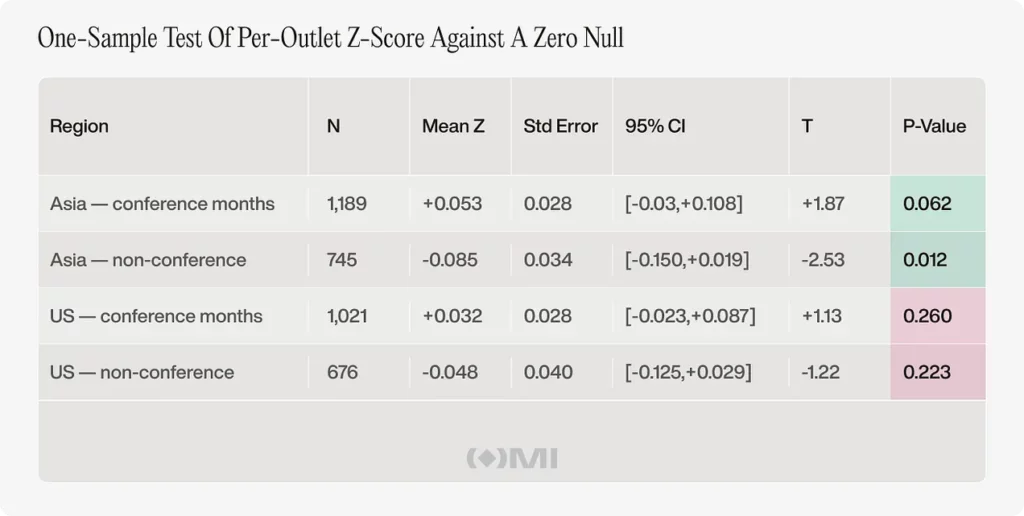
Asia looked stronger at first. Conference months ran about 1% above each outlet’s yearly average, and 4.5% above quieter months with no conference.
But even that 4.5% needs scale. In the original report, the median Asian outlet had around 69,700 monthly visits, so the conference-month lift worked out to roughly 3,100 extra visits. On a smaller 10,000-visit outlet, the same kind of bump is only about 700 visits.
However, much of the Asian lift came from a cluster of 27 Southeast Asian media outlets in October 2025, coinciding with TOKEN2049 in Singapore.
It was also the month Bitcoin hit its cycle high, followed by the market witnessing its largest single-day liquidation event just a week later. That makes the picture harder to read, as a traffic spike in a conference month does not by default mean the conference caused the spike.
Crypto readers flock to media outlets when something in the market demands attention, not just because an event is on the calendar. Fast price moves, broken leverage, new records, and sudden sell-offs can all create urgency that a conference alone cannot.
When we looked outside the conference calendar, Bitcoin kept showing up
January 2025 featured no Tier-1 conferences, yet it was the strongest readership month in the entire 15-month panel for both Asia and the U.S. In that month, 47.8% of Asian outlets and 55.7% of U.S. outlets cleared the “unusually strong” bar. By contrast, April 2025, which featured Paris Blockchain Week and TOKEN2049 Dubai, pushed only 14.5% of Asian outlets and 5.6% of U.S. outlets above that same line.
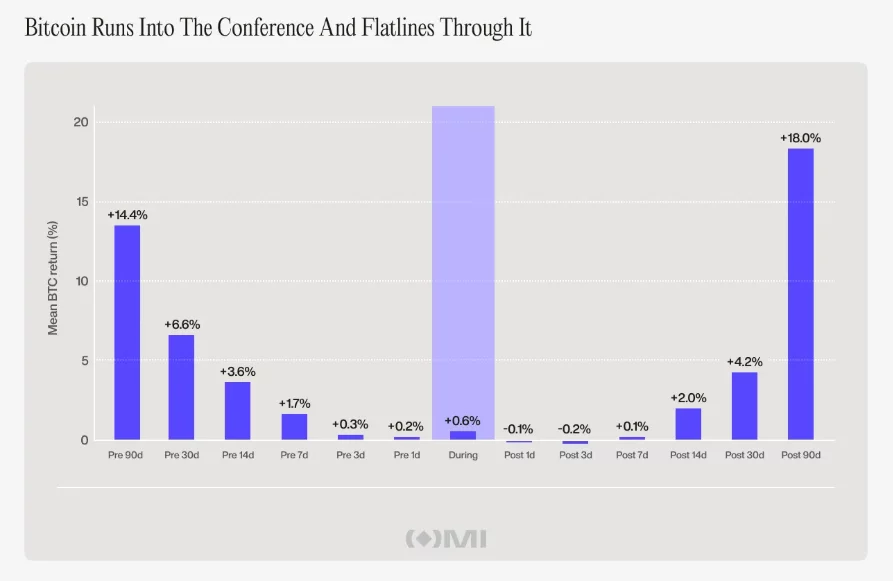
Bitcoin appears to explain this narrative. The world’s largest cryptocurrency by market cap averaged a 6.61% gain in the 30 days before Tier-1 conferences and rose before those events around 62% of the time.
Once the conference itself started, however, Bitcoin’s returns looked statistically similar to random windows of the same length. During actual conferences, BTC averaged about +0.63%, while random matching windows averaged +1.80%, which makes the event window hard to treat as special.
If Bitcoin rallies into an event, crypto media traffic may benefit from a boost. A sponsor could look at the month and assume the conference triggered a bump in total visits. But the data leaves open a simpler explanation: the price move may have created the attention, with a conference coincidentally happening in the background.
What we think sponsors should take from this
Conferences are still important because this is where founders interact with the community on a human level. Panels can provide valuable marketing opportunities and visibility, and side events can result in partnerships.
Those are real outcomes. Still, the data is less kind to the narrative that conference season reliably creates a broad media traffic gain. In the U.S., the impact was almost nonexistent, while in Asia, the lift was small and heavily shaped by one unusual month where a major conference, Bitcoin’s cycle top, and a historic liquidation event all collided.
Paying for the room, the meetings, and the stage still matters, especially for brand-building and relationship-driven outcomes. Just don’t assume the traffic will follow in the same way the narrative suggests.